


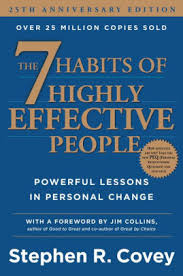
The 7 habits of highly effective people
Stephen R. Covey
This is an exceptionally good and timeless book. Dr. Covey was a fine teacher and story teller and those skills are on display here. In spite of his success, he remained humble, admitting his struggles to live the "7 Habits". This book is a classic business read and will help you identify how to be more of what you want to be. Helping you to address the habits that are holding you back from your next step.
'The new leader's 100-day action plan' Bradt, Check, Pedraza
isbn 978-0470407035
 We recommend this book because it provides the reader with real life examples for making a good start in a new company or when promoted to a new role. If applied well, you'll increase the odds of making an excellent start. Oftentimes the first 100 days are underestimated, while 40% of all executives fail in their new job, measured after 18 months! This book builds on a step by step approach for making the first impression, building your team, communicating your announcement to avoiding most of the common pitfalls and finally, making some quick wins. The book is suited for both seasoned and for new executives.
Geoff Smart, Randy Street and Alan Foster, Power score
isbn 978-0345547354
 The authors of the book Power Score serve up a credible way, for all the leftbrainers among us, to calculate how a successful management team can be translated into numbers. With this approach, they make the missing potential of a team visible. They suggest what you can do differently to achieve a higher score. Their formula measures three parameters:
- The priorities of the organization (the WHAT)
- Who will do it? The people in the management team that work on the priorities (HOW).
- Relationships. How do we work together here? (HOW)
Patrick Lencioni, The five dysfunctions of a team
isbn 978-0787960759
 Patrick Lencioni wrote a well-read book a few years ago called The five Dysfunctions of a Team. In it, he works with a pyramid of five levels. Management teams can not be effective, if they do not work well together on each of the different levels. You need to address each level before you can reach the next stage of the pyramid. For example, you should be able to trust one another before you can deal with conflicts in an effective way.